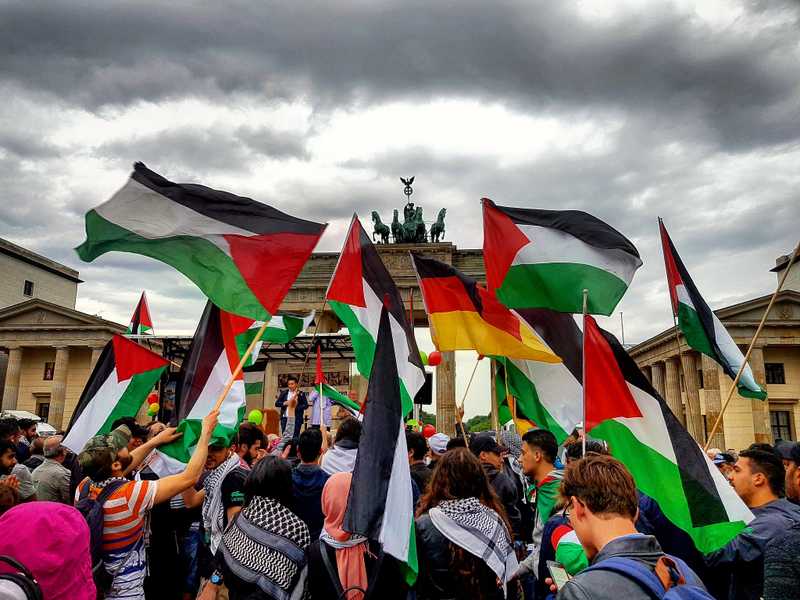
For centre-left liberals and EU advocates Germany has, in the twenty-first century, been viewed as a moral standard. Whether this was ever really the case or not is beside the point. Because whatever those of us on the left may think of Germany’s neo-liberal governance, we can probably agree liberal media like the Guardian have often fawned over it as a serious and stable global leader. Four months into 2024 we see a very different picture: its economy remains in recession, it is facing critical labour shortages, farmer protests shut down Berlin in December and, despite recent slip in the polls, the AfD, Germany’s main far-right party are looking to make significant ground in the upcoming election. But is its response to Israel’s onslaught in Gaza, crackdown on public expressions of support for Palestine and its unwavering support for the genocidal actions, which has made the country stand out. This has led to calls by Strike Germany, supported by more than 500 workers, for cultural workers to boycott German institutions, calling for an end to McCarthyite policies on freedom of expression.
For those unaware of Strike Germany and its aims, or those unaware of the German position on Israel more broadly, you might be wondering how different could things really be in Germany than, say Britain, where I live? But even by British standards, the German states support for Israel is near incomprehensible given the events of the last 6 months. Germany are Israel’s second biggest arms supplier behind the US, increasing their sales tenfold between 2022 and 2023. In January they rushed to announce their intention to intervene in South Africa’s case against Israel. More recently, on 1st March Nicaragua brought their case against Germany for contributing to the commission of genocide to the ICJ.
Where British MPs attempt to limit freedom of expression and shut down protests, and consistently enjoy smearing pro-Palestine protesters, particularly Muslim demonstrators as taking part in ‘hate marches’, in Germany the McCarthyite steps have come comparatively thick and fast. Many pro-Palestine marches have been banned, especially in the capital due to apparent fears of antisemitism, despite reports suggesting that over 90% of antisemitic hate crimes in Germany are committed by those with links to the far right. The phrase “From the river to the sea” is now a criminal offense, and those protests that have been allowed to go ahead have been heavily policed and criticised by the state, with hundreds reportedly having been arrested since October 7. Jewish anti-Zionists in Germany have reported feeling considerable pressure on their freedom of expression, as they too have been victims of arrests, or accusations of antisemitism. Research by Emily Dische-Becker has suggested that, absurdly, almost a third of those ‘cancelled’ by state-funded German institutions for alleged antisemitism have been Jewish.
Even before October 7, the German government have criminalised pro-Palestine speech. When it comes to limiting the impact of the BDS campaign, the government were way ahead of the curve, passing an anti-BDS resolution in 2020, to the dismay of 32 prominent cultural institutions and over 1000 artists and academics. In June of last year police arrested 12 demonstrators at a Nakba commemoration organised by Jewish Voice for a Just Peace in the Middle East. Germany prides itself on their ability to confront and commemorate the horrors of the Holocaust, but why does this right of commemoration, or freedom of expression not extend as far as the Palestinian cause?
In popular culture and social spaces, Germany also appears exceptional. In many popular spaces of culture in other countries, even Britain despite its normally tepid and mild-mannered nature, support for Palestine is high, and not unexpected. But in Germany, spaces which have typically been progressive, at least to varying degrees, have taken on the state’s McCarthyite policy of suppression of pro-Palestinian discourse. HÖR Berlin, ran by two Israelis who served in the IDF, removed two streams of DJs wearing clothing expressing support for Palestine, leading to many DJs choosing to remove their sets from the platforms YouTube page. World-famous nightclub, Berghain, has also been accused of cancelling the event of Arabian Panther for their support of Palestine. Blitz Munich recently cancelled a line up which hosted globally recognised DJ’s including Blawan, JASSS and LCY because of alleged antisemitism through pro-Palestine social media posts calling for the dissolution of the apartheid state and return of Palestinian land.
In academic circles too, the suppression of dissenting voices on the ‘conflict’ has been felt. The Guardian were quick to pick up on the irony of Masha Gessen initially not being awarded the Hannah Arendt prize for their writing on Gaza, pointing out that the rules on what academics can say about Israel would mean even Arendt herself, highly critical of the Israeli state, wouldn’t be eligible for the prize. In a bizarre turn of events, where a joint Palestinian-Israeli documentary on the plight of displaced Palestinians in the West Bank won a prize at the Berlinale, after controversy over her obvious applause, the Minister for Culture declared she was only applauding the Israeli director. It’s clear that in many instances, even independent social and cultural spaces are towing the line on Israel, and support for the Zionist ideology is apparently embedded in German society. This is the German Left’s Palestine problem.
So, what has led to Germany, a country once seen as the liberal sensible state, to its position today? How can the country which has an enormous Muslim population, and indeed substantive Palestinian population, and has accepted more refugees than any other in Europe, now seem hell bent on alienating these people, as well as progressives and anti-colonialists more generally, through its unquestioning solidarity with Israel?
It’s obvious that the horrors of the Holocaust being central to Germany’s recent history has led to their unreserved support for Israel. In the past, they have been praised for confronting the violence of their history, where others have failed, not least the US genocide against the Native Americans, the violence of the British Empire or indeed the savage treatment of the Congolese by Belgium, now home to the neo-liberal utopia/hell-scape of the EU. The German states official approach to coming to terms with the past is one of ‘Erinnerungskultur’ or a culture of remembrance. This means, in short, a society which properly confronts and interacts with its own history, hence the many monuments and memorial sites, robust education policies and frank educational experiences for German students and tourists alike. All sounds positive in this instance.
However, the celebrated culture of remembrance has come under scrutiny. First, within German cultural memory, the Holocaust is incomparable to any other historic tragedy. It is removed from politics, removed from history. Callinicos has rightly argued that “the point of Holocaust commemoration is surely not only to acknowledge the suffering of the victims but also to help sustain a political consciousness that is on guard against any signs of the repetition of Nazi crimes.” But Germans have keenly treated the holocaust as a singular event in history. This does not grapple with the conditions which lay the foundations for the emergence of fascism, conditions which are continually present today: racial capitalism, social inequalities and cultures of fear and othering. We cannot remove events in history from their context. We cannot treat them as singular. Otherwise we are doomed to create an ahistorical approach to history, something reactionary and fascist forces capitalise on.
Despite Germany’s supposed remembrance culture, it continues to limit the boundaries of this to the Holocaust and to Europe, in relating itself to its own notions of genocide as well as antisemitism and Judaism – ‘how dare anyone try to tell us about antisemitism – we invented it!’ In focusing on Europe alone, memory culture implicitly suppresses dissenting and marginalised voices on histories of genocide and violence. This suppression has in cases become explicit, such as that of Achille Mbembe whose Ruhrtriennale address was cancelled due to his comments on Palestinian oppression.
In fact, the comparisons made to Britain’s inability to repair the harm done by its empire only serves to highlight the German states inability to contend with its own colonial past – indeed any ability to look beyond Europe’s boundaries. That is why Namibia have invoked the genocide of their people at the hands of the Germans between 1904 and 1907 at the ICJ, highlighting that the country had yet to full atone for this “forgotten genocide”. And it is this inability to confront imperialism that has brought in Germany, as in Britain, the Netherlands and France, a continued orientalist logic about the middle east. A logic where in brown peoples are considered savage, uncivilised, ‘the enemy’. So within German memory culture, when these factors of orientalism, colonial amnesia and the heavy guilt and shame about the Holocaust on German soil, coalesce it creates a unique situation on the Palestinian genocide in the German psyche.
This connects to what has become one of the most toxic by-products of the culture of remembrance in Germany, which is its unwavering support for Israel. Those on all sides of mainstream politics have, for some I’m sure in good faith, tried to apparently atone for their past, and highlight, for all the world to see, their solidarity with the Jewish people. In the political sphere this has been conflated with supporting Israel and Zionism at any cost and refuting any attempts to connect any actions of the Israeli government to anything remotely similar to the holocaust – say, speaking in the language of genocide. And this is in the form of not only rhetoric which has long contended that Israeli security is the German states raison d’etre, but cash, arms and bureaucratic strength in the EU. However, by supporting the Israeli states genocidal intentions in Gaza, remembrance culture is evoked as nothing but an empty propaganda tool. It is used to shed the states continued guilt onto Palestinian people, to recreate antisemitism as an Arab problem, to not have to actively contend with the European antisemitism which laid the foundations for the horrors of the holocaust.
This politicised idea of remembrance implies that anyone, Jewish anti-Zionists included, cannot stand against the Zionist state, or acknowledge the complexity of Jewish culture and history before Zionism, or before the Holocaust. In doing so they perpetuate both antisemitism onto these Jewish anti-Zionists by homogenising all Jewish interests, and racism onto Palestinians and Arabs, by exporting their own guilt and shame, creating orientalist conceptions of the anti-Semitic, radical and dangerous Palestinian.
For the mantra of never again to be anything more than an empty propaganda slogan, showing “just how much” the Germans have changed, it must be politically active. It must be tangible. It must be about more than coming to terms with the past, but about using the lessons of the past to grapple with contemporary problems. It must mean never again, anywhere, to anyone.
For more information on Strike Germany, visit their website at: https://strikegermany.org/
For more information on the Boycott, Divest and Sanctions movement visit: https://bdsmovement.net/
 RED SCARE
Leave a comment